
Apple AirPods 5 Review: ANC, Spatial Audio, and USB-C Convenience
Product Context
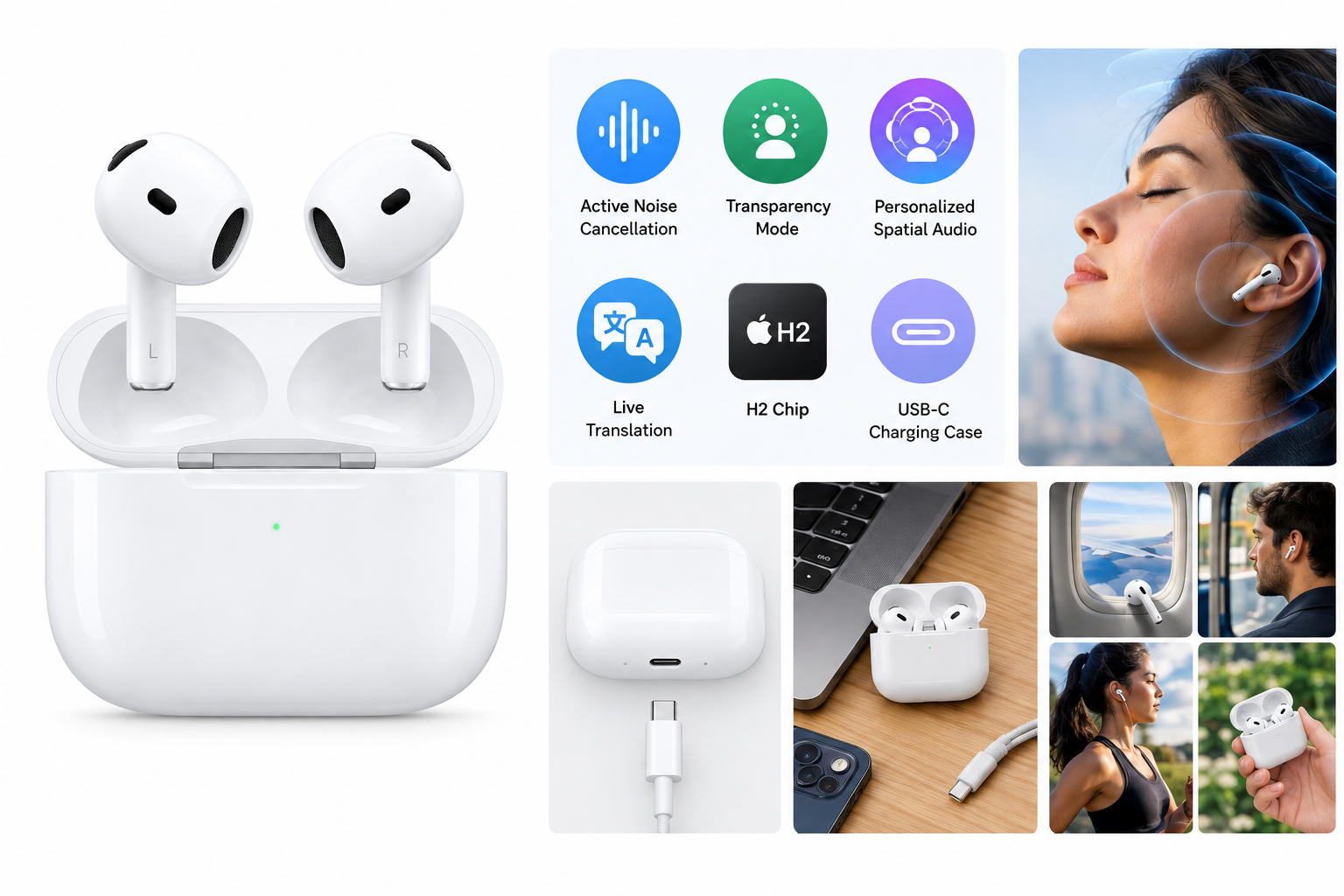
The Apple AirPods 5 Wireless Earbuds are positioned as feature-rich Bluetooth earbuds for users who want a compact listening solution with modern noise-control and Apple ecosystem features. The product listing highlights active noise cancellation, Personalized Spatial Audio, Live Translation, a USB-C charging case, and the H2 chip.
This combination makes the earbuds suitable for everyday listening, commuting, calls, travel, and users who frequently move between music, podcasts, video, and voice-based features. Their strongest appeal is likely to come from Apple device owners who value automatic pairing and integrated software controls.
Feature Breakdown
Active Noise Cancellation and Transparency Mode
The earbuds include Active Noise Cancellation, Adaptive Audio, and Transparency mode. Active Noise Cancellation is designed to reduce surrounding sound, which can be useful in offices, public transportation, and other busy environments. Transparency mode serves the opposite purpose by allowing more awareness of voices and nearby sounds without fully removing the earbuds.
Adaptive Audio is intended to balance noise reduction and environmental awareness automatically. This can reduce the need to switch listening modes manually during changing situations, although the experience may vary depending on the environment and fit.
Personalized Spatial Audio
Personalized Spatial Audio is designed to create a more immersive presentation for compatible music, films, television programs, and other content. The feature can make supported media feel more spacious than conventional stereo playback, particularly when used with head-tracking capabilities on compatible Apple devices.
Its value depends on content support and personal preference. Some listeners may enjoy the wider presentation, while others may prefer standard stereo for music or spoken-word content.
H2 Chip and Apple Integration
Apple’s H2 chip supports the earbuds’ processing features, including noise control and device interaction. In practical use, the chip is part of the broader Apple experience, helping the earbuds work smoothly with compatible devices and system features.
Apple ecosystem integration is one of the main reasons to consider this product. Users with compatible iPhone, iPad, or Mac devices can generally expect a more unified experience than they would receive from many third-party Bluetooth earbuds.
Live Translation
The product listing identifies Live Translation as a feature for communicating across languages. This capability may be useful for travel, conversations, or multilingual situations, but its usefulness depends on device compatibility, supported languages, software availability, and the conditions in which it is used.
Live Translation should be viewed as a convenience feature rather than a replacement for a professional interpreter, especially in complex or high-stakes conversations.
USB-C Charging Case
The included charging case uses USB-C, making it easier to share cables with newer phones, tablets, laptops, and other accessories. The case also provides a portable way to store and recharge the earbuds between listening sessions.
The listed contents include the AirPods 5 earbuds and a wireless charging case. Buyers who want a complete charging setup should confirm whether a charging cable or power adapter is included with the specific package they select.
Performance Insights
The AirPods 5 are designed to deliver a versatile listening experience rather than focus on a single use case. Active Noise Cancellation should be most useful for reducing steady background sounds, while Transparency mode is better suited to walking, working around other people, or hearing announcements.
For music and video, Personalized Spatial Audio can add a more immersive effect when supported by the content and paired device. The H2 chip also supports the product’s computational audio features, helping combine noise control, spatial processing, and device-level integration in a compact format.
Because this review is based on the listed specifications rather than independent laboratory testing, actual sound quality, microphone performance, noise reduction, and battery endurance should be evaluated according to the user’s device, fit, software version, and listening environment.
Usability
The AirPods 5 should appeal to users who prioritize a straightforward wireless experience. A compact earbud design and charging case make the product practical for commuting, travel, exercise, and general daily use. USB-C charging also reduces cable clutter for users who already use USB-C devices.
The product is likely to be easiest to use within Apple’s ecosystem, where pairing, controls, spatial-audio settings, and other features can be managed through compatible Apple hardware and software. Android users may still be able to use core Bluetooth audio functions, but some advanced features may require Apple devices or may not be available in the same way.
As with any open or semi-open earbud design, comfort and stability can vary from person to person. Buyers who need a highly secure fit for intense workouts should pay close attention to the earbud shape and return policy.
Trade-offs
The AirPods 5 offer a broad feature set, but several trade-offs are worth considering:
- Advanced features such as Personalized Spatial Audio and Live Translation may depend on compatible Apple devices, supported content, software, and languages.
- Noise cancellation performance can vary with ear shape, fit, background noise, and the type of sound being reduced.
- Users outside the Apple ecosystem may not receive the full benefit of the product’s integration features.
- The earbuds may not provide the same level of passive isolation or workout security as models with sealed ear tips or stabilizing wings.
- The product’s overall value depends heavily on whether the buyer will regularly use features such as ANC, Adaptive Audio, Spatial Audio, and Apple device integration.
Conclusion
The Apple AirPods 5 Wireless Earbuds are a feature-focused option for listeners who want active noise cancellation, Adaptive Audio, Personalized Spatial Audio, Live Translation, USB-C charging, and Apple-oriented connectivity in one compact product. Their main strengths are the breadth of supported features and the potential for smooth integration with compatible Apple devices.
They are best suited to users who already rely on Apple hardware and want earbuds that can transition between music, calls, video, travel, and voice-assisted features. Buyers who prioritize maximum workout stability, extensive Android controls, or highly customizable sound may want to compare the fit and ecosystem limitations carefully before choosing them.