
KODAK PIXPRO FZ55 Review: Simple 16MP Compact Camera for Everyday Point‑and‑Shoot Photos
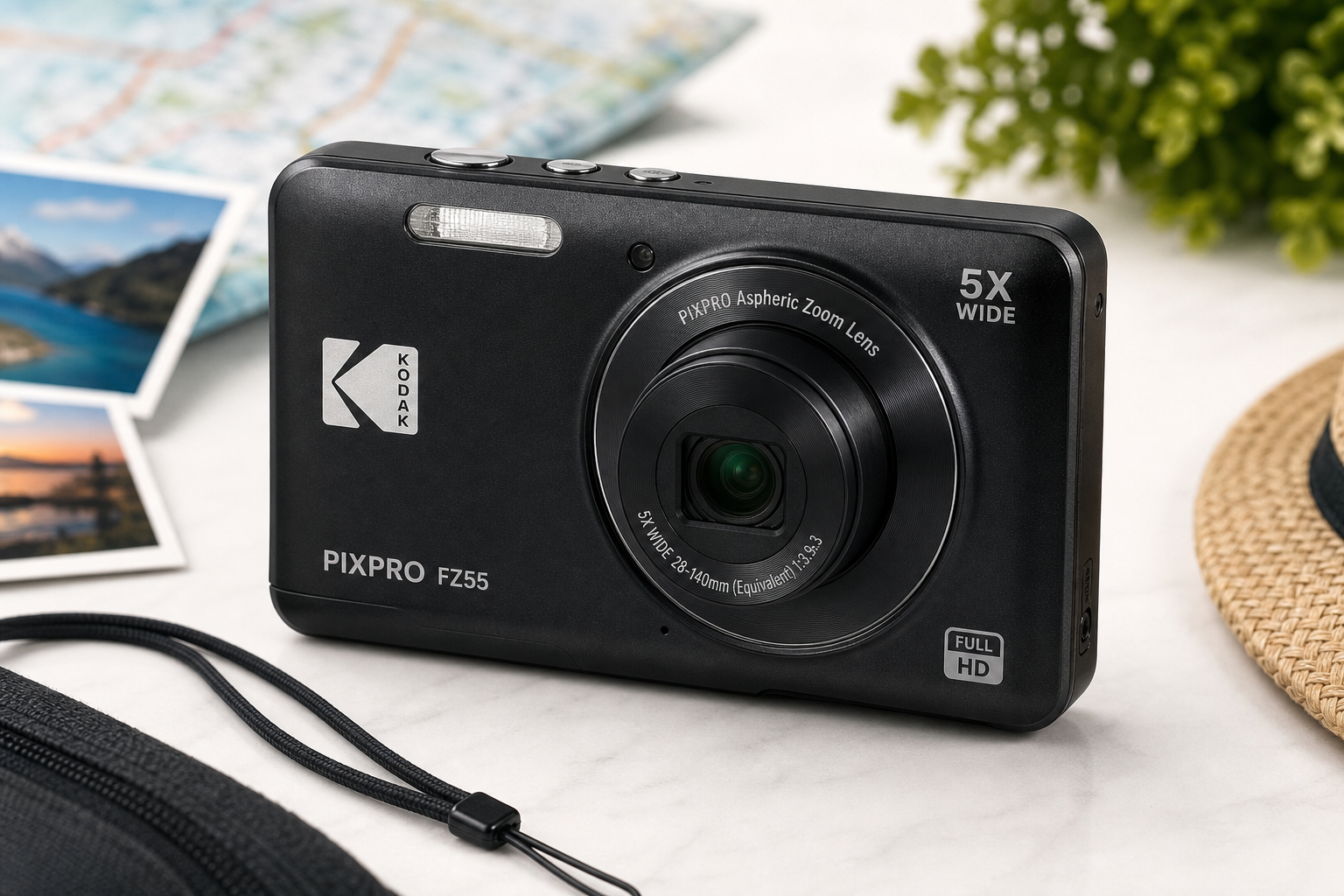
KODAK PIXPRO FZ55 16MP Compact Digital Camera, 5X Optical Zoom, Black
Product Context
The KODAK PIXPRO FZ55 16MP Compact Digital Camera, 5X Optical Zoom, Black is part of Kodak’s “Friendly Zoom” line: small, lightweight point‑and‑shoot cameras designed for simplicity and everyday carry rather than professional work. It pairs a 16.35MP 1/2.3" CMOS sensor with a 5x optical zoom lens (28–140mm full‑frame equivalent) and records 1080p Full HD video.
At a high level, the FZ55 targets:
- Casual users and families who want a separate camera so they don’t rely entirely on a phone.
- Travelers looking for a slim camera that fits in a pocket or small bag.
- Beginners and kids who need straightforward controls and automatic exposure.
- Entry‑level vloggers who simply need 1080p video and a compact form factor.
Compared with a smartphone, the FZ55 offers a real optical zoom, a traditional camera handling experience, and dedicated physical controls. Compared with more advanced compact cameras, it is much simpler: mostly auto‑everything, no RAW capture, a basic LCD, and digital-only stabilization. The overall proposition is convenience and zoom reach in a low‑complexity, pocketable body.
Feature Breakdown
Sensor and Image Resolution
- 16.35MP 1/2.3" CMOS sensor
- Maximum still resolution: 4608 × 3456 (16MP, 4:3 aspect ratio)
- Additional resolutions in 4:3, 3:2, and 16:9, down to 0.3MP for small files
This sensor size and resolution are typical for basic compact cameras. You can comfortably produce prints at common sizes, share images online, and crop moderately without severe quality loss, as long as light is reasonably good.
Lens and Zoom Range
- 28–140mm equivalent focal length (5.1–25.5mm actual)
- 5x optical zoom
- Maximum aperture: f/3.9 (wide) to f/6.3 (telephoto)
- Digital zoom up to 6x (combined 30x zoom when optical + digital are used)
At the wide end, 28mm is useful for:
- Landscapes and cityscapes
- Indoor group shots
- Travel scenes where you want to capture more of the environment
At 140mm equivalent, you can frame portraits from a comfortable distance or zoom in on details at events or while sightseeing. The lens is not especially fast, so it favors well-lit outdoor scenes or indoor environments with decent lighting.
Image Stabilization
- Digital Image Stabilization only (no optical or mechanical stabilization)
Digital stabilization helps smooth minor hand movements in both stills and video, but it is not a substitute for optical stabilization. To get the best results, you still need steady hands, especially in low light or when zoomed in.
Video Capabilities
- 1080p Full HD video at 30 fps
- 1280 × 720 at 30 or 60 fps, and 640 × 480 at 30 fps
- High-speed mode: 640 × 480 at up to 120 fps for short slow‑motion clips
- MOV file format using Motion JPEG video and mono audio
Video quality is serviceable for casual use—vacations, family events, and basic vlogging. Motion JPEG produces large files compared with modern codecs but is broadly compatible with editing software.
Display and Controls
- 2.7" LCD screen
- Fixed (non‑tilting) display
- Menu‑driven operation with directional pad and dedicated buttons
The 2.7‑inch screen is smaller than many current cameras and smartphones, but it keeps the body compact. The interface focuses on automatic operation, scene modes, and simple settings adjustments rather than granular manual control.
Power and Storage
- Uses a rechargeable Li‑ion battery (LB‑012, 3.7V 700mAh)
- In‑camera USB charging supported
- Standard SD/SDHC memory cards
In‑camera charging is convenient when traveling; you can top up the camera from a power bank, car charger, or laptop.
Other Notable Features
- Built‑in flash for low‑light snapshots
- Macro focusing down to 5 cm (wide angle only), useful for close‑ups of small objects
- Tripod socket for steady shots and fixed-position vlogging
Overall, the feature set is intentionally basic but covers the essentials for point‑and‑shoot photography and straightforward 1080p video.
Performance Insights
Image Quality in Good Light
In bright outdoor or well‑lit indoor conditions, the FZ55 can produce pleasing, sharp images suitable for sharing and small prints. The 16MP resolution gives enough detail for:
- Vacation photos and city scenes
- Family gatherings and birthday parties
- Everyday snapshots of pets, food, or objects
Color rendering tends toward a familiar consumer‑camera look: moderately saturated colors and contrast that is slightly punchy but generally flattering. For casual use, this is often preferable to a flatter, more neutral profile that would demand more editing.
Low‑Light Performance
Low‑light performance is constrained by three factors:
- Small 1/2.3" sensor, which introduces noise as ISO rises.
- Modest maximum aperture (f/3.9–6.3), which limits how much light can reach the sensor.
- Digital-only stabilization, which is less effective than optical stabilization at slower shutter speeds.
In practice, this means:
- Night scenes and dim indoor environments may show visible noise and softer detail.
- The camera may use slower shutter speeds, so motion blur from subject movement or camera shake is more likely.
- The built‑in flash becomes useful, but it can create a typical small‑camera flash look (bright foreground, darker background).
For users who mostly shoot in daylight or moderately lit interiors, this is acceptable. For frequent night or indoor action photography, this model is not ideal.
Autofocus and Responsiveness
The FZ55 uses a contrast‑detect autofocus system typical of compact cameras in this class. For static subjects in good light, autofocus is generally reliable. Real‑world behavior includes:
- Adequate focus speed for casual photography.
- Occasional hunting in low light or at longer focal lengths.
- Better performance when you give the camera a brief moment to lock focus before fully pressing the shutter.
Shot‑to‑shot times are reasonable for a basic compact; you can capture sequences of everyday moments but not fast action bursts or sports.
Video Quality in Practice
1080p video from the FZ55 is appropriate for:
- Documenting trips and local outings
- Recording family events
- Straightforward talking‑to‑camera vlogging in good light
Highlights and shadows are handled competently in moderate contrast scenes. The small sensor and basic processing mean fine detail and dynamic range lag behind more advanced cameras or high‑end smartphones, but for simple documentation, it suffices.
Because there is no sophisticated stabilization, you’ll get smoother results if you:
- Hold the camera with both hands and keep your elbows close to your body.
- Use a small tripod or mini‑grip when filming yourself.
- Avoid rapid pans and sudden movements.
Audio comes from a built‑in mono microphone, which is fine for casual recordings but not a substitute for dedicated audio gear.
Usability
Design and Ergonomics
The FZ55 emphasizes portability:
- Slim, compact body that fits into a jacket pocket or small purse.
- Light enough to carry all day without fatigue.
- Simple controls with familiar button layout.
There is no deep handgrip, but the camera’s low weight makes it easy to hold. A wrist strap is strongly recommended, especially when shooting one‑handed or handing the camera to kids.
Learning Curve for Beginners
Users migrating from smartphones or older point‑and‑shoots will find the interface intuitive:
- Auto modes take care of exposure, white balance, and most decisions.
- Scene modes offer one‑touch presets for landscapes, portraits, night scenes, and more.
- The menu system focuses on clear icons and straightforward options, rather than complex photographic jargon.
This makes the FZ55 approachable for:
- First‑time camera users
- Children and students
- People who prefer not to deal with manual exposure settings
Everyday Convenience
In daily use, the camera’s strengths are:
- Always‑ready physical controls that work even with gloves or in bright sunlight where phone screens can be hard to see.
- A dedicated shutter button and zoom rocker that provide tactile feedback.
- A clear separation between personal phone and shared family camera, which some households prefer.
Battery life is adequate for a typical day of casual shooting when fully charged, especially if you avoid excessive reviewing of images and long video clips. In‑camera USB charging helps you top up easily.
Vlogging Use Case
For basic vlogging, the FZ55 offers:
- 1080p recording that is simple to edit and share.
- A compact, inconspicuous body suitable for filming in public.
- A 28mm wide end that can work for arm’s‑length self‑recording, though some may wish it were slightly wider.
Limitations for vloggers include:
- The non‑articulating screen, which makes it hard to frame yourself perfectly.
- No external microphone jack, so audio capture is limited to the built‑in mic.
- Digital stabilization only, which may result in shakier handheld footage.
For casual updates, social clips, and travel diaries, these trade‑offs may be acceptable. For more polished content, creators may prefer a camera with a flip screen and better stabilization.
Trade-offs
Because the KODAK PIXPRO FZ55 is built for simplicity and portability, it involves several compromises that are important to understand.
Advantages
- True 5x optical zoom (28–140mm equivalent) gives more framing flexibility than most fixed‑lens phones.
- Compact and lightweight design makes it easy to carry almost anywhere.
- Straightforward operation with auto modes and scene presets, ideal for beginners.
- 1080p Full HD video that meets basic vlogging and documentation needs.
- Macro capability down to 5 cm (at wide angle) for close‑ups of small subjects.
- Dedicated camera experience separate from your phone, which some users value for privacy or focus.
Limitations
- No optical image stabilization; digital stabilization is less effective, especially in low light.
- Small 1/2.3" sensor limits performance in dark conditions and reduces dynamic range.
- Relatively slow lens (f/3.9–6.3) compared with some premium compacts, contributing to low‑light challenges.
- 2.7" fixed LCD that neither tilts nor flips, making self‑framing and low‑angle shots less convenient.
- No advanced manual controls or RAW capture, which will frustrate users who want to grow into more serious photography.
- Build and longevity are serviceable but not ruggedized; as with most slim compacts, the telescoping lens mechanism can be vulnerable to shocks or debris, so careful handling is important.
Understanding these trade‑offs makes it easier to decide if the FZ55’s strengths align with your needs.
Conclusion
The KODAK PIXPRO FZ55 16MP Compact Digital Camera, 5X Optical Zoom, Black occupies a clear niche: it is a simple, pocketable point‑and‑shoot that delivers a real optical zoom lens, decent 16MP stills, and 1080p video in an easy‑to‑use package. Its strengths are convenience, lightweight design, and beginner‑friendly operation.
It is best suited to:
- Casual photographers who primarily shoot in good light and value a dedicated camera.
- Travelers craving a small camera with more zoom versatility than a basic phone.
- Families wanting a straightforward, shareable camera for vacations and events.
- New or younger users learning basic photography on an uncomplicated device.
On the other hand, photographers who need strong low‑light performance, advanced manual control, robust stabilization, or professional‑grade video will quickly run into the camera’s limits and should consider more advanced compacts or entry‑level interchangeable‑lens systems.
If your priorities are simplicity, portability, and optical zoom for everyday snapshots, the FZ55 remains a practical option. Evaluating it as a friendly, no‑frills point‑and‑shoot—rather than a replacement for high‑end cameras or flagship smartphones—will help set realistic expectations and determine whether it’s the right fit for your photography style.