
Garmin dezl OTR720 (Renewed) Review: A Truck-Focused 7" GPS Navigator with Pro-Grade Routing
Product Context
Garmin dezl OTR720, Large 7" GPS Navigator, Custom Truck Routing, Satellite Imagery, Wind Speed, Community-Shared Loading Docks & Parking Availability (Renewed) is a 7‑inch trucking GPS designed for professional drivers who need more than generic car navigation. Built around Garmin’s dēzl platform, it targets over‑the‑road, regional, and dedicated route drivers who want:
- Custom routing based on truck size, weight, and cargo profile
- Advanced arrival tools like high‑resolution satellite imagery for docks and yards
- Real‑time and community‑contributed information about truck parking and loading areas
- A dedicated, always‑on navigation device that doesn’t depend on phone signal
This specific listing is renewed, meaning it’s a refurbished unit that has been restored to working condition and resold, typically with inspection and cleaning. Functionally, it is meant to deliver the same navigation experience as the new dēzl OTR720, but at a lower cost and with some trade‑offs in cosmetic condition and long‑term wear.
Feature Breakdown
7" high‑resolution trucking display
The dēzl OTR720 uses an approximately 6.95‑inch color TFT capacitive touchscreen with a super‑wide viewing angle. The display is tuned for in‑cab use: bright, with good contrast and a layout optimized for glanceable turn prompts and lane guidance. For drivers who keep the device mounted at arm’s length on the windshield or dash, the 7" size strikes a balance between readability and windshield real estate.
Key display characteristics:
- Capacitive multi‑touch panel for smartphone‑like pinch‑to‑zoom
- Wide viewing angles for visibility from different seating positions
- Truck‑oriented map themes and large data fields
Custom truck routing
One of the key reasons to buy the Garmin dezl OTR720 (Renewed) over a generic GPS or smartphone app is its truck‑aware routing engine. During setup, you can create profiles including:
- Vehicle height, length, width, and gross weight
- Axle configuration and potentially hazardous materials
- Trailer profiles (length and type)
The device then uses these parameters to avoid:
- Low bridges and height‑restricted underpasses
- Weight‑restricted roads and bridges
- Roads with truck bans, seasonal restrictions, or tight turns (where data is available)
Garmin also overlays alerting for upcoming hazards, such as:
- Bridge heights
- Sharp curves and steep grades
- Weight limits and other truck‑relevant warnings
These features are not perfect—data coverage varies by region and you still need to obey posted signs—but they are a meaningful upgrade over car‑focused navigation.
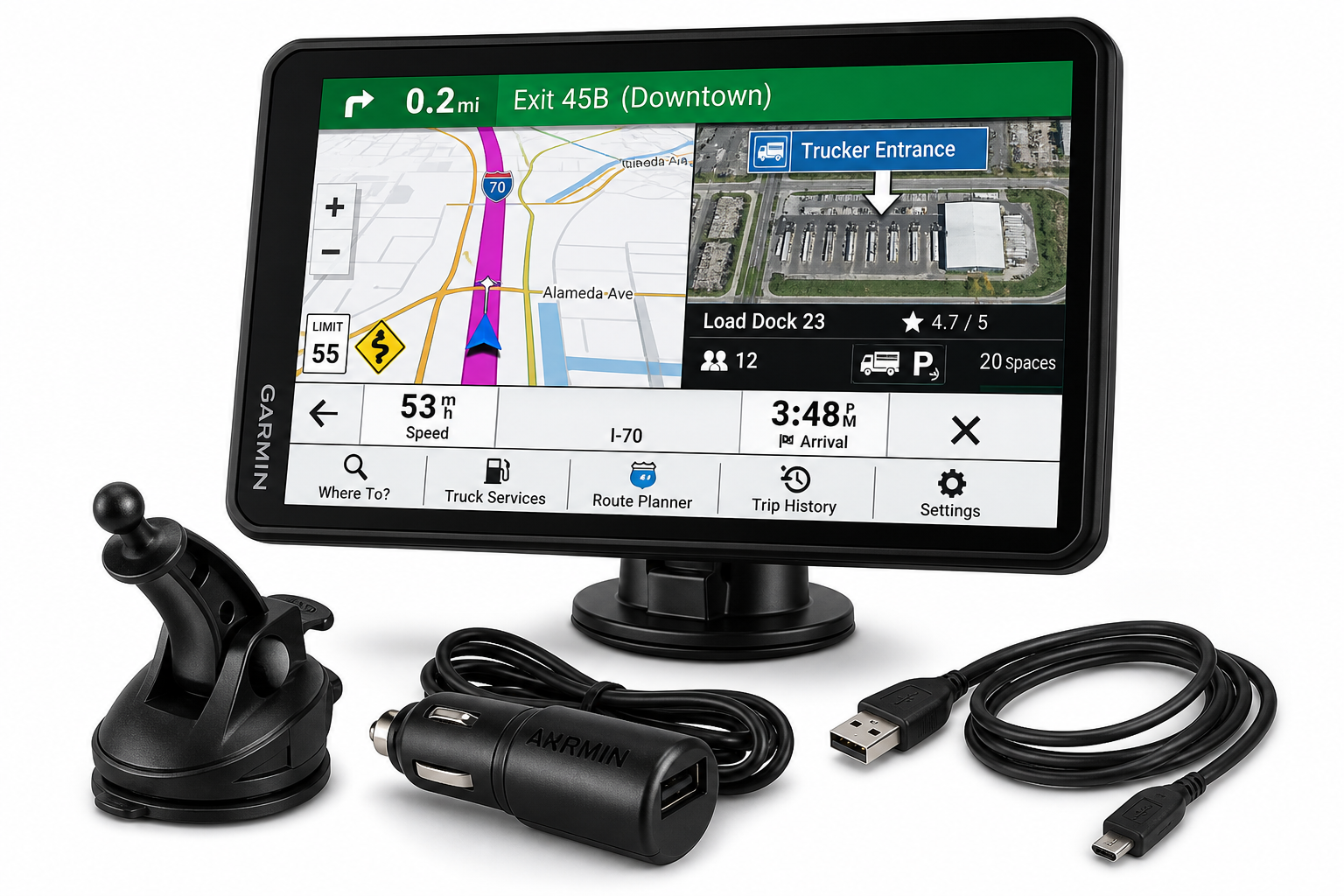
BirdsEye Direct satellite imagery & expert arrival planning
A standout capability of the OTR720 is its BirdsEye Direct satellite imagery support. This gives you high‑resolution overhead views of:
- Distribution centers and warehouses
- Truck entrances and security gates
- Complex yards or industrial parks
Garmin positions this as expert arrival planning: instead of guessing which driveway to use or circling a large facility, you can visually confirm the correct entrance and approach path while still en route. For new customers or unfamiliar terminals, this can reduce stress, wrong turns, and backing maneuvers in tight spaces.
Truck parking, loading docks, and services directory
The community‑shared loading docks & parking availability feature is designed to tackle one of the biggest pain points in trucking: safe, legal parking. The device integrates:
- A directory of truck stops, rest areas, and service facilities
- User‑contributed information about loading docks and parking
- Filters for amenities (fuel, repair, food, showers, etc.)
In supported areas, you can search ahead on your route for parking options and get a sense of availability before committing. Community data is never complete, but having it directly on the GPS reduces the need to juggle multiple apps on your phone.
Wind speed and driving condition awareness
The OTR720 platform supports wind speed information along your route when connected to compatible live services. Strong crosswinds can significantly affect vehicle stability, especially for high‑profile trailers; having proactive alerts can help you:
- Anticipate dangerous segments
- Adjust speed and lane position
- Decide whether to reroute or pause for safety
This is not a replacement for proper weather planning, but it adds another layer of situational awareness directly on your navigation screen.
Connectivity and companion features
The dēzl OTR720 integrates with Garmin’s ecosystem for enhanced functionality:
- Bluetooth: Pair with a smartphone to enable hands‑free calling and access live services (traffic, weather, smart notifications), depending on region and plan.
- Garmin apps: The dēzl‑specific companion app can sync trip data, addresses, and updates. With the optional Garmin eLog accessory and app, compatible dēzl units—including the OTR720—can be used as part of a compliant electronic logging device (ELD) system in jurisdictions where Garmin eLog is supported.
- Garmin Express (PC/Mac): Used to update maps and firmware over USB, ensuring you have the latest truck routing and POI data.
Hardware and included accessories
Typical inclusions for this model line are:
- dēzl OTR720 GPS unit
- Vehicle suction‑cup mount or dashboard mount
- Vehicle power cable (12V CLA adapter)
- Basic documentation
Because this is a renewed product, packaging may be generic, and included accessories may be refurbished or replaced with equivalent items, but functionality is intended to match the original bundle.
Performance Insights
Real‑world navigation behavior
In practice, the OTR720 is oriented toward long‑haul and regional trucking where consistent routing, lane guidance, and arrival planning matter more than flashy graphics.
Typical performance characteristics include:
- Routing quality: For major truck corridors and interstates, routing is generally solid and conservative. It aims to keep you on truck‑legal routes and prefers larger roads when possible.
- ETA accuracy: With a dedicated GPS receiver and truck‑centric speed assumptions, ETAs are often more realistic for heavy vehicles than consumer car GPS devices or phone apps configured for passenger cars.
- Lane guidance and junction view: On complex interchanges, the device highlights the correct lane and may show photorealistic junction views, improving clarity in unfamiliar cities.
Satellite imagery at the last mile
Where available, BirdsEye Direct imagery makes the final mile more predictable:
- You can preview the layout of a yard before arrival.
- You’re less likely to miss an unmarked truck entrance or find yourself at a car‑only gate.
- It’s particularly helpful at night or in poor weather, where signs and markings may be hard to see.
Coverage is not global or perfect, but for major freight hubs, it can meaningfully reduce arrival friction.
Reliability and renewed‑unit considerations
As a renewed device, the Garmin dezl OTR720 has been restored to a functional state; however, buyer experiences with refurbished electronics can vary.
Typical observations with renewed GPS units:
- Core navigation generally works as on new units, assuming firmware is up to date.
- Cosmetic wear (minor scuffs, light scratches) may be present but usually does not affect usability.
- Some users of similar OTR720 units have reported occasional random shutdowns or reboots, which can be disruptive in city driving. While not universal, it highlights the importance of:
- Installing the latest firmware updates via Wi‑Fi or Garmin Express
- Using a stable power source and firm mount
- Monitoring behavior early in the return window so any defective unit can be exchanged
Renewed devices typically go through a quality check, but subtle issues like intermittent power or touch sensitivity may only surface after extended use.
Usability
Setup and configuration
Initial setup involves:
- Selecting language and region.
- Creating a truck profile with dimensions, weight, and other parameters.
- Pairing with a smartphone (optional) for live services.
- Updating maps and firmware.
For most drivers, the on‑device menus are straightforward, but the sheer number of options (profiles, alerts, map layers) can be overwhelming at first. Spending time fine‑tuning your profiles is worthwhile because routing depends heavily on accurate vehicle data.
In‑cab ergonomics
In daily use, the OTR720 feels purpose‑built for the truck cab:
- The 7" screen is readable even when mounted further from the driver.
- Large on‑screen buttons reduce the need for precise taps while the vehicle is stopped.
- Voice prompts are generally clear, and volume is adequate for noisy cabs when properly positioned.
The device supports both windshield and dash mounting, though many drivers prefer dash‑level placement to minimize windshield obstruction.
Interface and workflow
The main menu layout prioritizes:
- “Where To?” search
- Saved/favorite locations
- Route planning and trip history
- Points of interest, including truck stops, rest areas, and services
Searching can be done by address, business name, category, or coordinates. For some regional contexts, especially outside North America or in smaller towns, address lookup may require additional patience or the use of coordinates shared by dispatch.
Integration with logging and compliance tools
For fleets or owner‑operators interested in ELD integration, the OTR720 can work with a Garmin eLog adapter (sold separately) in certain jurisdictions. When configured, the device can display hours‑of‑service information and assist with break planning. This reduces the number of separate screens and gadgets in the cab.
Trade-offs
Advantages
- Truck‑aware routing: Safer and more appropriate for heavy vehicles than general‑purpose navigation apps when used correctly.
- BirdsEye satellite imagery: Adds real value for complex arrivals, yards, and unfamiliar DCs.
- Community‑shared docks and parking: Helps address parking scarcity and loading‑dock discovery.
- 7" dedicated display: Always‑on navigation without depending on phone battery, reception, or data caps.
- Garmin ecosystem: Access to live traffic, weather, and optional ELD capabilities via Garmin eLog.
- Renewed value proposition: Functionally similar to a new unit, with a lower up‑front cost and, usually, some form of return policy.
Limitations
- Renewed condition risk: Refurbished electronics can include units with prior heavy use. While inspected, long‑term durability and battery health may vary compared to brand‑new stock.
- Occasional stability reports: Some users of the OTR720 line have experienced random shutdowns or reboots. Keeping firmware updated and verifying the power connection is essential.
- Data limitations: Truck restrictions, parking availability, and dock information are never perfectly up to date. You still must obey posted signs and use judgment.
- Learning curve: Advanced features (profiles, satellite imagery, ELD integration, dock search) take time to master, especially for drivers accustomed to simple phone navigation.
- Single‑ecosystem focus: Deep integration assumes you are comfortable with Garmin’s apps and tools; mixing platforms (multiple non‑Garmin systems) can add complexity.
Conclusion
The Garmin dezl OTR720, Large 7" GPS Navigator, Custom Truck Routing, Satellite Imagery, Wind Speed, Community-Shared Loading Docks & Parking Availability (Renewed) is a capable, truck‑centric GPS solution that delivers meaningful advantages over generic navigation apps for professional drivers. Its combination of custom truck routing, BirdsEye satellite imagery, parking and dock information, and integration with Garmin’s connected services makes it especially appealing for OTR and regional drivers who regularly encounter unfamiliar shippers, receivers, and tight yards.
Opting for the renewed version can make this pro‑grade feature set more accessible, provided you are comfortable with the typical caveats of refurbished hardware: cosmetic imperfections, potentially reduced battery longevity, and the small but real possibility of firmware or stability quirks. For drivers who prioritize truck‑aware routing and expert arrival planning and are willing to invest a little time in configuration and updates, the renewed dēzl OTR720 remains a strong, work‑focused navigation tool that can simplify daily operations and reduce stress on the road.